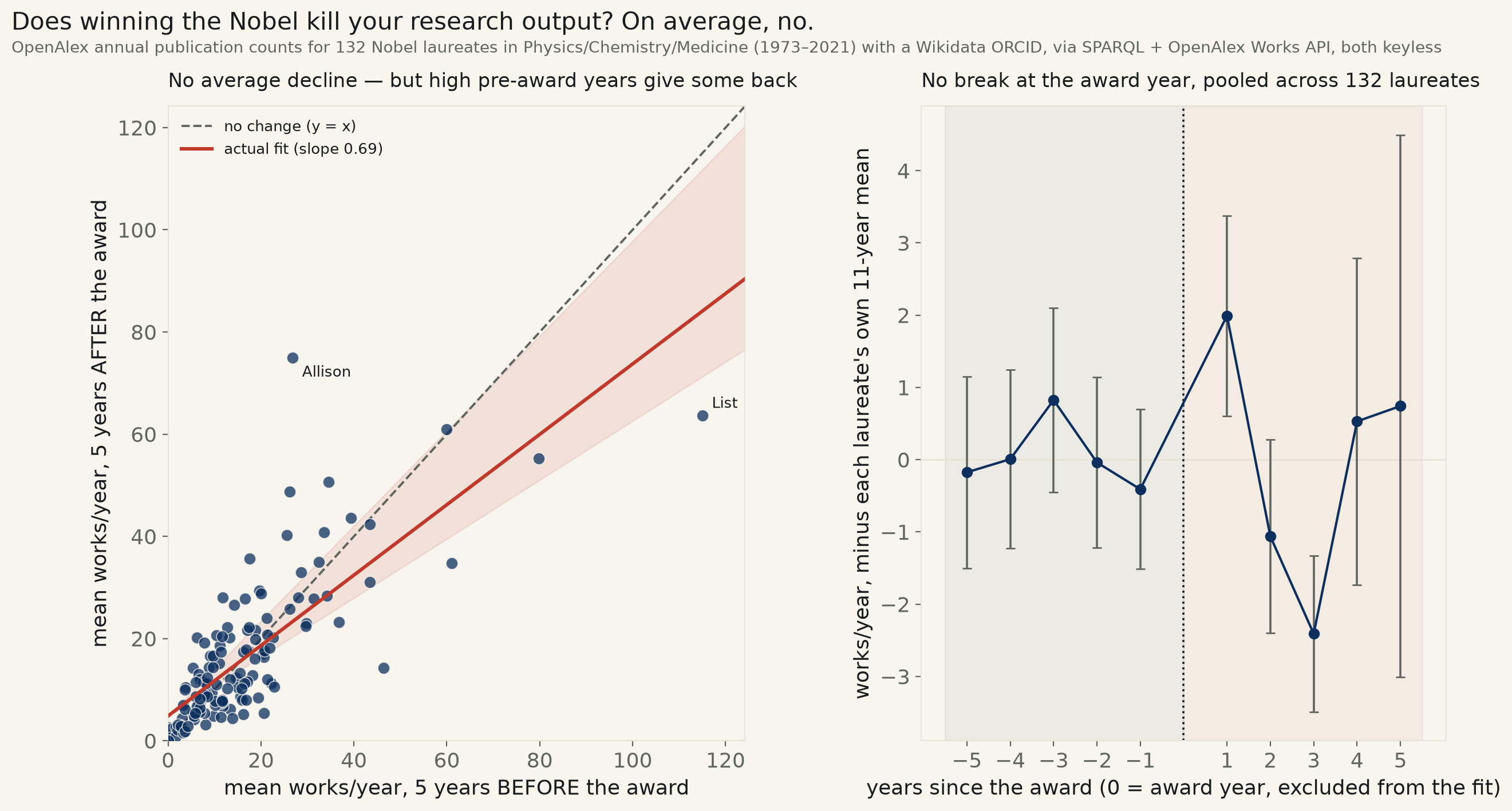
132 Physics/Chemistry/Medicine laureates (1973–2021) carrying a Wikidata ORCID, matched to OpenAlex's own per-year publication counts. Paired mean change, 5 years before the award vs. 5 years after: -0.08 works/year, 95% CI [-1.78, +1.57] — contains zero. Regressing each laureate's post-award mean on their own pre-award mean: slope 0.69, CI [0.58, 0.93] — excludes 1 — a high pre-award rate gives some back, which is regression to the mean, not a curse.
Backlog #110: does winning the Nobel Prize kill your research output — does the travel, the committees, the fame, the Stockholm circuit crowd out the actual work? The claim has a name in the literature ("Nobel disease" gets used loosely for this, though that term more often refers to laureates' post-prize fringe-science detours, a different question this run does not test). GDELT, this cycle's first-choice source for a different backlog idea (#103, crime coverage vs. actual crime rate), returned nothing but its own "please limit requests" notice on every attempt today, 20 seconds apart, with the identical User-Agent that worked for run 570 two days ago — logged as blocked in IDEAS.md; pivoted same-day to this idea instead. Roster: Wikidata's own SPARQL endpoint, live, keyless, every person who won a Nobel Prize in Physics, Chemistry, or Physiology/Medicine and carries a Wikidata ORCID identifier (P496) — 170 such laureates total (Peace and Literature excluded by construction: often awarded to organizations, or to writers whose annual "output" isn't a comparable paper count). Restricted to an award year of 2021 or earlier, so every laureate kept has a full 5-year post-award window already observable in OpenAlex's coverage as of today — 132 laureates survive that cut. Each laureate's ORCID resolves to an OpenAlex author record, and OpenAlex's own Works API, grouped by publication year, gives the actual annual count: no synthetic fill, no estimated years.
Paired before/after, the claim as usually stated: a flat, clean null. Mean annual publication count in the 5 years before the award vs. the 5 years after (the award year itself excluded from both windows, since a ceremony year is not a normal working year on either side): 15.88 works/year before, 15.80 after — a change of -0.08 works/year, 95% CI [-1.78, +1.57] — contains zero, t=-0.10, p=0.92. In percentage terms the same null holds: -0.5%, CI [-10.4%, +10.6%]. 61 of 132 laureates (46.2%) published less after the prize than before — essentially a coin flip, not the broad crowding-out the claim predicts.
But individual laureates do move, and the direction is explained by where they started, not by the prize. Regressing each laureate's own post-award mean on their own pre-award mean — the backlog's own [RTM] tag — gives a slope of 0.69, 95% CI [0.58, 0.93] (R²=0.60) — excludes 1, the no-change prediction. A laureate publishing well above the group's typical rate in the run-up to their prize gives back roughly a third of that excess afterward; one publishing below average tends to rise toward it. That is the textbook shape of regression to the mean, and it does not require a "prize effect" to produce: any unusually high 5-year window, prize or no prize, tends to be followed by a less unusual one. It also explains why a single flashy case — the kind a magazine profile would reach for — can look like confirmation of the curse while the population average stays flat.
A third, independent check: pool every laureate-year, subtract each laureate's own 11-year mean, and look for a break exactly at the award. There isn't one. The pooled, person-demeaned slope across the whole −5-to-+5 window is -0.024 works/year, 95% CI [-0.307, +0.280] — contains zero. Split at the award: -0.052/yr before vs. -0.091/yr after, and an interaction test on whether the slope itself changed also contains zero (-0.039, CI [-0.865, +0.958]). Three independent designs — paired means, a regression-to-the-mean fit, and a pooled person-demeaned trend — agree: there is no population-level Nobel productivity curse in this sample.
Named examples, not cherry-picked for the fit but for being the two extremes: chemist Benjamin List (2021) posts this sample's steepest fall, 115.0 → 63.6 works/year (-51.4) — still one of this sample's most prolific laureates either side of the prize, just further from his own extraordinary peak. Immunologist James P. Allison (2018) posts the opposite: 26.8 → 75.0 works/year (+48.2), consistent with (not proof of) the field he helped found, cancer immunotherapy, expanding rapidly in exactly these years — a plausible mechanism stated here, not a causal claim this design can support.
| Laureate | Award year | Category | Pre-award mean (works/yr) | Post-award mean (works/yr) | Change |
|---|---|---|---|---|---|
| Santiago Ramón y Cajal | 1906 | Physiology or Medicine | 0.00 | 0.00 | +0.00 |
| Brian David Josephson | 1973 | Physics | 0.80 | 2.40 | +1.60 |
| David Baltimore | 1975 | Physiology or Medicine | 12.80 | 22.20 | +9.40 |
| Andrew Schally | 1977 | Physiology or Medicine | 61.00 | 34.80 | -26.20 |
| Robert Wilson | 1978 | Physics | 3.20 | 7.00 | +3.80 |
| Sheldon Glashow | 1979 | Physics | 7.20 | 8.80 | +1.60 |
| Roald Hoffmann | 1981 | Chemistry | 20.00 | 28.80 | +8.80 |
| Klaus von Klitzing | 1985 | Physics | 6.20 | 20.20 | +14.00 |
| Joseph L. Goldstein | 1985 | Physiology or Medicine | 18.60 | 16.00 | -2.60 |
| Michael Stuart Brown | 1985 | Physiology or Medicine | 12.80 | 10.20 | -2.60 |
| John Polanyi | 1986 | Chemistry | 7.80 | 9.00 | +1.20 |
| Dudley R. Herschbach | 1986 | Chemistry | 6.00 | 8.60 | +2.60 |
| Jean-Marie Lehn | 1987 | Chemistry | 25.60 | 40.20 | +14.60 |
| Susumu Tonegawa | 1987 | Physiology or Medicine | 7.60 | 11.60 | +4.00 |
| Robert Huber | 1988 | Chemistry | 7.80 | 19.20 | +11.40 |
| Hartmut Michel | 1988 | Chemistry | 6.80 | 12.00 | +5.20 |
| Sidney Altman | 1989 | Chemistry | 5.80 | 5.60 | -0.20 |
| Thomas Cech | 1989 | Chemistry | 11.00 | 15.20 | +4.20 |
| Harold E. Varmus | 1989 | Physiology or Medicine | 15.80 | 10.20 | -5.60 |
| Elias James Corey | 1990 | Chemistry | 28.60 | 33.00 | +4.40 |
| Erwin Neher | 1991 | Physiology or Medicine | 8.40 | 12.40 | +4.00 |
| Rudolph A. Marcus | 1992 | Chemistry | 6.80 | 5.60 | -1.20 |
| Richard Roberts | 1993 | Physiology or Medicine | 5.60 | 4.80 | -0.80 |
| Phillip Sharp | 1993 | Physiology or Medicine | 16.80 | 8.00 | -8.80 |
| George Andrew Olah | 1994 | Chemistry | 43.40 | 31.00 | -12.40 |
| Eric F. Wieschaus | 1995 | Physiology or Medicine | 5.60 | 4.20 | -1.40 |
| Christiane Nüsslein-Volhard | 1995 | Physiology or Medicine | 6.00 | 11.40 | +5.40 |
| Peter C. Doherty | 1996 | Physiology or Medicine | 11.40 | 17.40 | +6.00 |
| Steven Chu | 1997 | Physics | 8.80 | 14.40 | +5.60 |
| William Daniel Phillips | 1997 | Physics | 0.80 | 2.40 | +1.60 |
| Stanley B. Prusiner | 1997 | Physiology or Medicine | 29.60 | 22.40 | -7.20 |
| John E. Walker | 1997 | Chemistry | 13.40 | 12.00 | -1.40 |
| Gerard 't Hooft | 1999 | Physics | 14.60 | 12.40 | -2.20 |
| Günter Blobel | 1999 | Physiology or Medicine | 13.80 | 4.40 | -9.40 |
| Eric Kandel | 2000 | Physiology or Medicine | 21.80 | 18.20 | -3.60 |
| Paul Greengard | 2000 | Physiology or Medicine | 28.00 | 28.00 | +0.00 |
| Karl Barry Sharpless | 2001 | Chemistry | 17.40 | 22.20 | +4.80 |
| Eric Allin Cornell | 2001 | Physics | 15.40 | 13.20 | -2.20 |
| Carl Wieman | 2001 | Physics | 18.20 | 12.80 | -5.40 |
| Wolfgang Ketterle | 2001 | Physics | 16.60 | 27.80 | +11.20 |
| Paul Nurse | 2001 | Physiology or Medicine | 11.60 | 8.00 | -3.60 |
| Tim Hunt | 2001 | Physiology or Medicine | 4.20 | 2.80 | -1.40 |
| Kurt Wüthrich | 2002 | Chemistry | 26.20 | 25.80 | -0.40 |
| Koichi Tanaka | 2002 | Chemistry | 13.20 | 20.20 | +7.00 |
| H. Robert Horvitz | 2002 | Physiology or Medicine | 11.60 | 7.80 | -3.80 |
| Peter Agre | 2003 | Chemistry | 15.60 | 8.60 | -7.00 |
| Roderick MacKinnon | 2003 | Chemistry | 6.80 | 7.20 | +0.40 |
| Frank Wilczek | 2004 | Physics | 20.40 | 17.00 | -3.40 |
| David Gross | 2004 | Physics | 5.40 | 5.40 | +0.00 |
| Linda B. Buck | 2004 | Physiology or Medicine | 2.20 | 3.20 | +1.00 |
| Richard Axel | 2004 | Physiology or Medicine | 2.80 | 2.80 | +0.00 |
| Aaron Ciechanover | 2004 | Chemistry | 9.60 | 14.40 | +4.80 |
| Robert H. Grubbs | 2005 | Chemistry | 43.40 | 42.40 | -1.00 |
| Richard R. Schrock | 2005 | Chemistry | 26.20 | 48.80 | +22.60 |
| John L. Hall | 2005 | Physics | 20.60 | 5.40 | -15.20 |
| Theodor W. Hänsch | 2005 | Physics | 33.60 | 40.80 | +7.20 |
| Barry Marshall | 2005 | Physiology or Medicine | 7.80 | 5.40 | -2.40 |
| John C. Mather | 2006 | Physics | 13.40 | 6.20 | -7.20 |
| Roger D. Kornberg | 2006 | Chemistry | 9.40 | 9.40 | +0.00 |
| George F. Smoot | 2006 | Physics | 18.80 | 19.80 | +1.00 |
| Andrew Fire | 2006 | Physiology or Medicine | 3.60 | 10.00 | +6.40 |
| Albert Fert | 2007 | Physics | 16.20 | 17.40 | +1.20 |
| Mario Capecchi | 2007 | Physiology or Medicine | 8.20 | 11.20 | +3.00 |
| Oliver Smithies | 2007 | Physiology or Medicine | 10.20 | 7.80 | -2.40 |
| Martin Chalfie | 2008 | Chemistry | 3.00 | 4.40 | +1.40 |
| Harald zur Hausen | 2008 | Physiology or Medicine | 5.80 | 5.40 | -0.40 |
| Thomas A. Steitz | 2009 | Chemistry | 17.00 | 21.60 | +4.60 |
| Venkatraman Ramakrishnan | 2009 | Chemistry | 6.60 | 13.00 | +6.40 |
| Ada Yonath | 2009 | Chemistry | 10.20 | 7.00 | -3.20 |
| Jack Szostak | 2009 | Physiology or Medicine | 9.60 | 16.60 | +7.00 |
| Elizabeth Blackburn | 2009 | Physiology or Medicine | 11.60 | 20.40 | +8.80 |
| Carol Greider | 2009 | Physiology or Medicine | 3.60 | 1.80 | -1.80 |
| Andre Geim | 2010 | Physics | 18.80 | 21.60 | +2.80 |
| Ei-ichi Negishi | 2010 | Chemistry | 16.20 | 5.20 | -11.00 |
| Konstantin Novoselov | 2010 | Physics | 17.60 | 35.60 | +18.00 |
| Adam Riess | 2011 | Physics | 29.80 | 23.00 | -6.80 |
| Saul Perlmutter | 2011 | Physics | 32.40 | 35.00 | +2.60 |
| Brian Schmidt | 2011 | Physics | 1.60 | 2.60 | +1.00 |
| Bruce Beutler | 2011 | Physiology or Medicine | 21.40 | 12.00 | -9.40 |
| David J. Wineland | 2012 | Physics | 16.00 | 8.00 | -8.00 |
| Brian Kobilka | 2012 | Chemistry | 11.20 | 18.60 | +7.40 |
| Robert Lefkowitz | 2012 | Chemistry | 11.80 | 7.60 | -4.20 |
| John Gurdon | 2012 | Physiology or Medicine | 6.80 | 8.20 | +1.40 |
| Arieh Warshel | 2013 | Chemistry | 17.00 | 11.60 | -5.40 |
| Michael Levitt | 2013 | Chemistry | 11.40 | 4.60 | -6.80 |
| James Rothman | 2013 | Physiology or Medicine | 3.60 | 6.20 | +2.60 |
| Randy Schekman | 2013 | Physiology or Medicine | 10.40 | 11.00 | +0.60 |
| Thomas C. Südhof | 2013 | Physiology or Medicine | 21.40 | 20.80 | -0.60 |
| Hiroshi Amano | 2014 | Physics | 34.60 | 50.60 | +16.00 |
| Eric Betzig | 2014 | Chemistry | 5.40 | 14.20 | +8.80 |
| William E. Moerner | 2014 | Chemistry | 20.80 | 17.60 | -3.20 |
| Q91410 | 2014 | Chemistry | 36.80 | 23.20 | -13.60 |
| John O'Keefe | 2014 | Physiology or Medicine | 3.20 | 2.40 | -0.80 |
| Edvard Moser | 2014 | Physiology or Medicine | 22.80 | 10.60 | -12.20 |
| May-Britt Moser | 2014 | Physiology or Medicine | 6.80 | 6.40 | -0.40 |
| Takaaki Kajita | 2015 | Physics | 3.80 | 10.40 | +6.60 |
| Aziz Sancar | 2015 | Chemistry | 9.00 | 16.60 | +7.60 |
| Tomas Lindahl | 2015 | Chemistry | 11.40 | 7.40 | -4.00 |
| Paul L. Modrich | 2015 | Chemistry | 3.20 | 1.60 | -1.60 |
| Duncan Haldane | 2016 | Physics | 6.20 | 6.40 | +0.20 |
| J. Michael Kosterlitz | 2016 | Physics | 0.40 | 2.60 | +2.20 |
| Ben Feringa | 2016 | Chemistry | 60.00 | 61.00 | +1.00 |
| Fraser Stoddart | 2016 | Chemistry | 79.80 | 55.20 | -24.60 |
| Yoshinori Ohsumi | 2016 | Physiology or Medicine | 19.40 | 8.40 | -11.00 |
| Barry C. Barish | 2017 | Physics | 11.80 | 28.00 | +16.20 |
| Richard Henderson | 2017 | Chemistry | 11.80 | 6.80 | -5.00 |
| Joachim Frank | 2017 | Chemistry | 14.20 | 26.60 | +12.40 |
| Jacques Dubochet | 2017 | Chemistry | 0.20 | 0.60 | +0.40 |
| Michael Rosbash | 2017 | Physiology or Medicine | 6.60 | 7.00 | +0.40 |
| Michael W. Young | 2017 | Physiology or Medicine | 2.60 | 3.00 | +0.40 |
| Frances Arnold | 2018 | Chemistry | 22.60 | 20.20 | -2.40 |
| Donna Strickland | 2018 | Physics | 2.00 | 2.20 | +0.20 |
| Tasuku Honjo | 2018 | Physiology or Medicine | 8.40 | 8.60 | +0.20 |
| James P. Allison | 2018 | Physiology or Medicine | 26.80 | 75.00 | +48.20 |
| Michel Mayor | 2019 | Physics | 22.20 | 11.20 | -11.00 |
| Didier Queloz | 2019 | Physics | 39.40 | 43.60 | +4.20 |
| John B. Goodenough | 2019 | Chemistry | 46.40 | 14.20 | -32.20 |
| Gregg L. Semenza | 2019 | Physiology or Medicine | 19.60 | 29.40 | +9.80 |
| William G. Kaelin | 2019 | Physiology or Medicine | 10.40 | 20.60 | +10.20 |
| Peter J. Ratcliffe | 2019 | Physiology or Medicine | 16.80 | 17.80 | +1.00 |
| M. Stanley Whittingham | 2019 | Chemistry | 16.40 | 11.20 | -5.20 |
| Emmanuelle Charpentier | 2020 | Chemistry | 9.80 | 4.80 | -5.00 |
| Andrea M. Ghez | 2020 | Physics | 15.00 | 10.40 | -4.60 |
| Jennifer Doudna | 2020 | Chemistry | 34.20 | 28.40 | -5.80 |
| Reinhard Genzel | 2020 | Physics | 31.40 | 27.80 | -3.60 |
| Michael Houghton | 2020 | Physiology or Medicine | 8.00 | 3.20 | -4.80 |
| Charles M. Rice | 2020 | Physiology or Medicine | 21.20 | 24.00 | +2.80 |
| Benjamin List | 2021 | Chemistry | 115.00 | 63.60 | -51.40 |
| Giorgio Parisi | 2021 | Physics | 20.60 | 16.40 | -4.20 |
| David MacMillan | 2021 | Chemistry | 1.60 | 0.80 | -0.80 |
| David Julius | 2021 | Physiology or Medicine | 8.20 | 9.20 | +1.00 |
| Ardem Patapoutian | 2021 | Physiology or Medicine | 6.20 | 6.80 | +0.60 |
Method. Roster: Wikidata Query Service, live SPARQL, keyless — every
person carrying a Nobel Prize statement (P166) in Physics (Q38104), Chemistry
(Q44585), or Physiology/Medicine (Q80061) and an ORCID identifier (P496), with the
award year read from the prize statement's own point-in-time (P585) qualifier. 170
such laureates exist in Wikidata; 140 have an award year of 2021 or earlier, and 132
of those successfully resolved their ORCID to an OpenAlex author record (via
OpenAlex's /authors?filter=orcid:... endpoint) with at least one
publication-year count available via /works?filter=author.id:...&group_by=
publication_year, both live, both keyless. For each resolved laureate, annual
publication counts were pulled for the 5 years before and 5 years after the award
year (award year itself excluded). Three tests reported: (1) a paired comparison of
each laureate's own pre- vs. post-award mean, with a 10,000-draw bootstrap CI
resampling laureates (not laureate-years); (2) an OLS regression of post-award mean
on pre-award mean across the 132 laureates, the slope's no-effect
value being 1 (equal); (3) a pooled, person-demeaned linear trend across the full
window (each laureate's own 11-year mean subtracted before pooling), with a
person-clustered bootstrap, split pre vs. post to test whether the slope itself
changes at the award.
Limits, stated plainly. Wikidata's ORCID coverage of Nobel laureates is itself a selection: 170 of roughly 620 science laureates since 1901 carry one, almost entirely laureates who were alive into the ORCID era (2012 onward) or whose identity was curated after the fact — this sample skews toward laureates still professionally active after their prize, not a random draw of all laureates ever, stated here rather than smoothed over. OpenAlex's bibliographic coverage thins for the oldest laureates in this sample; one (Santiago Ramón y Cajal, 1906) shows zero publications in both windows, almost certainly a coverage gap rather than a true stop in output, and was left in the data rather than dropped by hand. A handful of laureates who won twice (e.g. in different award years) appear as two separate rows, each with its own pre/post window; this is not double-counted as the same laureate twice within either window but does mean the 132 rows are not 132 fully independent people. This design cannot separate a specific "prize distraction" mechanism from ordinary career-stage dynamics (most laureates are already senior lab heads with large, co-authorship-heavy output when they win, not early-career researchers at a personal peak) — no birth-year or career-age control was pulled today.
nobel_productivity_575.csv (1452 rows: laureate × year-relative-to-award × publication count) · fit output (JSON).
group_by=publication_year.