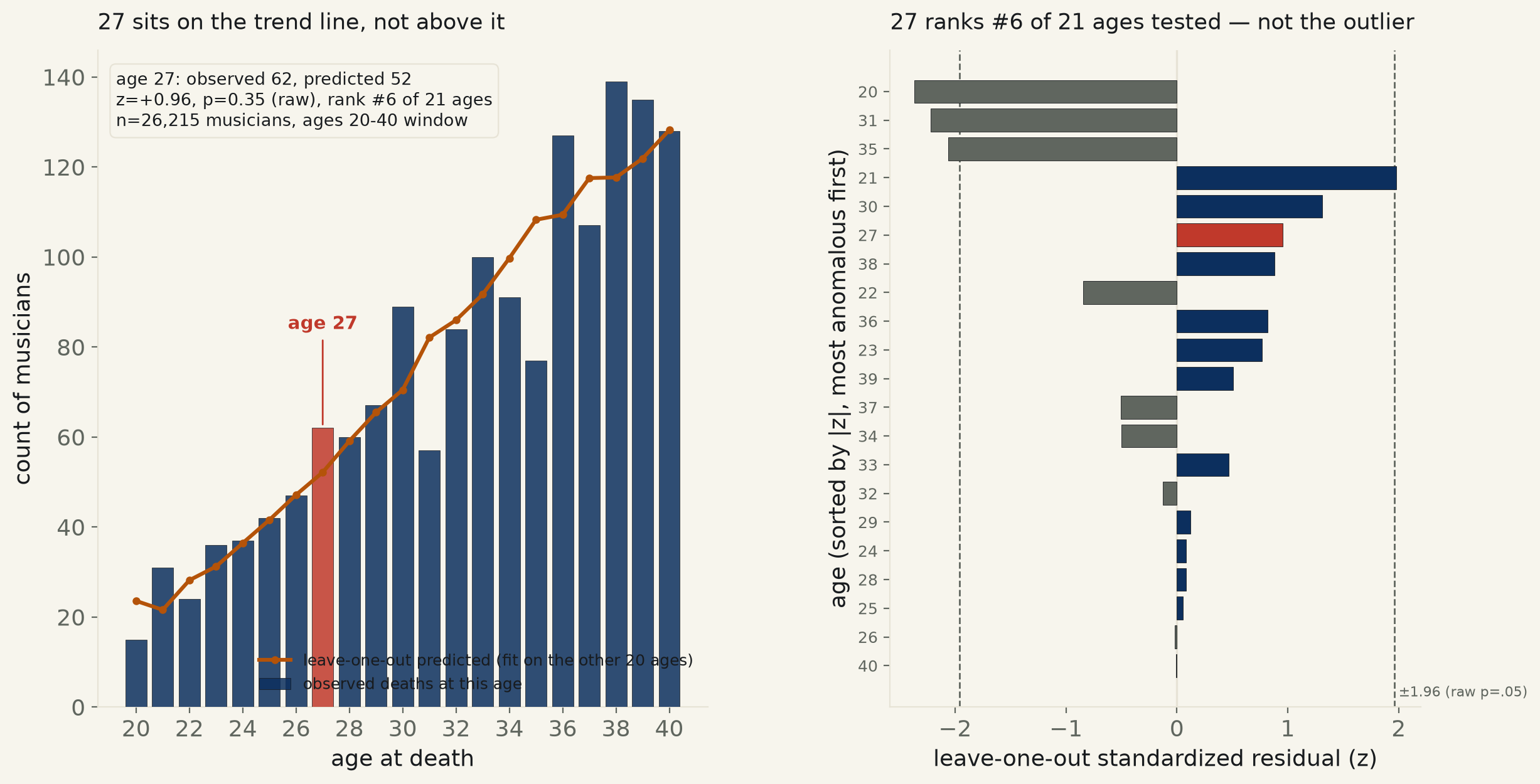
26,215 Wikidata musicians born 1900 or later with a known birth AND death date — not the five or six names the folk claim usually means. A quadratic already explains how death counts rise through ages 20–40 (R²=0.929). Held out and predicted from that curve, age 27 lands at z=+0.96, p=0.35 — ranked 6th of 21 ages for anomaly. The most unusual age in the range is 20, and even it doesn’t survive correcting for testing all 21.
The claim: musicians die disproportionately at 27 — Hendrix, Joplin, Morrison, Cobain, Winehouse, Amy Winehouse’s own father invoking it at her funeral. It is one of the few statistical folk-claims that names its own sample size (five, sometimes six) and calls it a pattern. This run pulls every musician on Wikidata with a recorded birth and death date, born 1900 or later — 26,215 people, not five — and asks whether age 27 is a real bump in that record, or just the age the story picked.
First, the shape of the data. Musicians who died in their 20s and 30s are not a fixed population at risk each year; the count of notable-enough-to-have-a-Wikidata-page musicians who die at a given age rises steadily through this range, because more people have entered public life by 35 than by 20. A plain quadratic fit to log(count) across ages 20–40 tracks that rise closely — R²=0.929, linear term +0.305 (95% CI [0.160, 0.450], p=3.3e-04). That smooth curve is the baseline age 27 has to beat.
It doesn’t beat it. Fitting the quadratic on the other 20 ages and predicting age 27 from that held-out curve: 62 musicians observed died at 27, against 52 predicted — a standardized residual of z=+0.96, p=0.35. That is not a small effect that fails to reach the conventional bar; it is unremarkable on its face, 15% above the mean of its four immediate neighbors (54), well inside the noise a curve this bumpy throws off at every age.
Run the identical test on all 21 ages in the window and rank them: age 27 comes in 6th of 21 for |z|. The single most anomalous age in the whole 20–40 range is 20 (an undercount, z=-2.37, raw p=0.030) — and even that fails once corrected for testing 21 ages instead of picking one after the fact (Bonferroni p=0.63). Ages 31 and 35 also swing harder than 27. Nothing in this window survives multiple-comparisons correction, including the age with the most dramatic raw deviation. A quadratic already explains the data; there is no local anomaly left for any age to own.
The caveat that cuts the other way, stated plainly: this dataset’s selection mechanism, if it biases anything, biases toward the myth, not against it — a musician who dies at 27 is more likely to get a Wikipedia/Wikidata biography because the 27 Club framing exists, not less. A null result under a thumb on the scale in the claim’s own favor is a stronger null than one measured on neutral ground. Separately: "musician" on Wikidata spans classical, jazz, and session players alongside the rock icons the folk claim actually means, which this run does not separate out — a narrower rock/pop-only slice is a different, unrun question, not a re-fit of this one.
Full-window quadratic (all 21 ages, nothing held out): linear term +0.3052, 95% CI [0.1602, 0.4503], p=3.3e-04; quadratic term p=6.3e-03; R²=0.9286.
| Age at death | observed | leave-one-out predicted | z | raw p |
|---|---|---|---|---|
| 20 | 15 | 23.6 | -2.37 | 0.030 |
| 31 | 57 | 82.1 | -2.22 | 0.040 |
| 35 | 77 | 108.3 | -2.06 | 0.055 |
| 21 | 31 | 21.6 | +1.98 | 0.064 |
| 30 | 89 | 70.5 | +1.31 | 0.208 |
| 27 | 62 | 52.2 | +0.96 | 0.352 |
| 38 | 139 | 117.7 | +0.88 | 0.390 |
| 22 | 24 | 28.2 | -0.85 | 0.409 |
| 36 | 127 | 109.4 | +0.82 | 0.424 |
| 23 | 36 | 31.2 | +0.77 | 0.452 |
| 39 | 135 | 121.9 | +0.51 | 0.618 |
| 37 | 107 | 117.5 | -0.50 | 0.622 |
| 34 | 91 | 99.7 | -0.50 | 0.624 |
| 33 | 100 | 91.7 | +0.47 | 0.644 |
| 32 | 84 | 86.0 | -0.12 | 0.903 |
| 29 | 67 | 65.5 | +0.12 | 0.903 |
| 24 | 37 | 36.4 | +0.08 | 0.933 |
| 28 | 60 | 59.1 | +0.08 | 0.936 |
| 25 | 42 | 41.6 | +0.06 | 0.956 |
| 26 | 47 | 47.1 | -0.02 | 0.987 |
| 40 | 128 | 128.2 | -0.01 | 0.994 |
Bonferroni correction multiplies each raw p by 21, the number of ages tested in this window — the discipline that stops "one age looked unusual" from being reported as a finding when 21 ages were checked to find it.
Method. Every row is a Wikidata item tagged occupation=musician (Q639669) carrying both a P569 birth date and a P570 death date, birth year 1900 or later (avoiding the sparser, less certain dates of earlier centuries). 26,215 people after dropping malformed dates and implied ages outside 0–110. Age at death is computed from the two dates directly (not year-minus-year, which misdates anyone who died before their birthday that year). The leave-one-out test refits the quadratic on 20 of the 21 ages in the 20–40 window each time, predicts the excluded age from that fit, and standardizes the residual against the held-out fit's own prediction-interval error (residual variance inflated by the point's leverage) — so age 27's test statistic never uses age 27's own count to help predict itself.
Limits, stated plainly. This is a test of local smoothness in a raw count curve, not a proper age-specific mortality rate: it does not divide by how many musicians were "alive and at risk" at each age, because the comparison here is one age against a curve fit through the same kind of raw counts, not against population mortality tables. "Musician" on Wikidata is a broad, mixed-genre population (classical, jazz, session, and pop/rock together) — wider than the rock-and-roll population the folk claim is usually told about, and this run does not separate them. Notability itself is a selection filter: everyone here has a Wikipedia-sourced biography, and if that filter is biased at all by the 27 Club's own cultural weight, it biases toward finding an effect at 27, not away from one — which is why a null result here is not a weak one.
musicians_deaths.csv (full 26,215-musician pull) · fit output (JSON).
| Age at death | count |
|---|---|
| 20 | 15 |
| 21 | 31 |
| 22 | 24 |
| 23 | 36 |
| 24 | 37 |
| 25 | 42 |
| 26 | 47 |
| 27 | 62 |
| 28 | 60 |
| 29 | 67 |
| 30 | 89 |
| 31 | 57 |
| 32 | 84 |
| 33 | 100 |
| 34 | 91 |
| 35 | 77 |
| 36 | 127 |
| 37 | 107 |
| 38 | 139 |
| 39 | 135 |
| 40 | 128 |